Projects
A project is a place where work happens: a repo, a company, your personal life admin. In APX it is a folder that
follows APC (Agent Project Context), an open standard: an AGENTS.md at the root and a .apc/ folder beside it.
Your agents, their instructions, the project’s skills and MCP servers all live in those files, so they travel with
the folder, show up in git diff, and can be read by any tool that understands the standard.
What is in a project
Section titled “What is in a project”Directoryacme-store/
- AGENTS.md what the project is and how to work in it
Directory.apc/
- project.json name, description and type
- memory.md your fixed notes for this project’s agents
- organization.json areas and roles (companies)
- mcps.json MCP servers for this project
Directoryagents/
- lucia.md
- tomas.md
- vera.md
Directory.archived/ removed agents land here, never erased
- …
Directoryskills/
Directoryweekly-report/
- SKILL.md
Directorysrc/
- …
- …
| File | What APX does with it |
|---|---|
AGENTS.md | Project context every agent here reads. Long files are capped at 12,000 characters, keeping the head and the tail. |
.apc/project.json | name, description and kind. A committed apx_id keeps the project’s id stable; a clone or worktree next to the original gets its own. |
.apc/agents/<slug>.md | One agent each. See Agents. |
.apc/memory.md | Notes you write by hand. Agents always read it and never write it (capped at 6,000 characters). |
.apc/skills/<name>/SKILL.md | Skills only this project’s agents get. See Skills. |
.apc/mcps.json | {"mcpServers": …} for this project, with no secrets in it. Each server must be trusted before it runs. See MCP servers. |
.apc/organization.json | Areas and roles for a company (up to 40 areas, 200 roles). |
APX watches .apc/ and AGENTS.md. Edit a file in your editor, save it, and the app picks it up a moment later.
Project types
Section titled “Project types”Each project has a type, picked when you add it or later in its settings:
| Type | For |
|---|---|
| Personal | Your own things. No team or structure. |
| App | An application people use. |
| Company | Areas, roles and an executive team. |
| Software | A library or CLI other programs use. |
| Other | None of the above. |
Only a Company gets areas and roles. Importing the executive team makes a project a company on its own.
Add a project
Section titled “Add a project”- In the sidebar, click New project.
- Under Where it lives, pick In a folder and choose the repo or folder, or No folder to make one inside
APX’s own folder (
~/.apx/v2/projects/<name>). - Give it a name (the folder’s, if you leave it empty), a type and a description, then Add.
If the folder has no AGENTS.md, APX writes a one-line one and creates .apc/. Nothing else in your folder is
touched.
Register a folder that already has an AGENTS.md or a .apc/:
❯ apx projects register ~/work/acme-store
Acme Store (p_3f9a1c0d7e21): 4 agents
List them. A ! means the folder is not on disk right now (a moved folder, an unplugged drive):
❯ apx projects
p_3f9a1c0d7e21     Acme Store               company
p_8b20e4f1a9c3   ! Northwind site           app
Read the files again by hand, for every project or one:
❯ apx projects sync p_3f9a1c0d7e21
read 1 projects · 4 agents · 0 archived
The base project
Section titled “The base project”Home and your global agents live in the base project. It has no folder: APX keeps its name and type, its agents work anywhere, and it can’t be deleted. You name it during setup and can rename it later; it stays the base project whatever you call it. When you want agents that work in a specific folder, make a project for that folder.
What APX keeps on its side
Section titled “What APX keeps on its side”The project folder is yours. Everything APX needs that is not part of the standard stays in APX’s home
(~/.apx/v2):
- The database (
apx.db): chats, runs, tasks, routines, notes, widgets and an index of your projects’ agents. The files stay the source of truth for agent definitions; the index is rebuilt from them. - APX’s side of the project:
~/.apx/v2/projects/<name>for a project APX made with no folder elsewhere, and~/.apx/v2/projects/<id>for every other one. Outside agents (Claude Code, Codex) in a project chat work there, never in your folder, so one project’s scratch files never land among another’s.
Code threads are the exception: they work in your project’s folder on purpose. See Conversations.
Inside a project
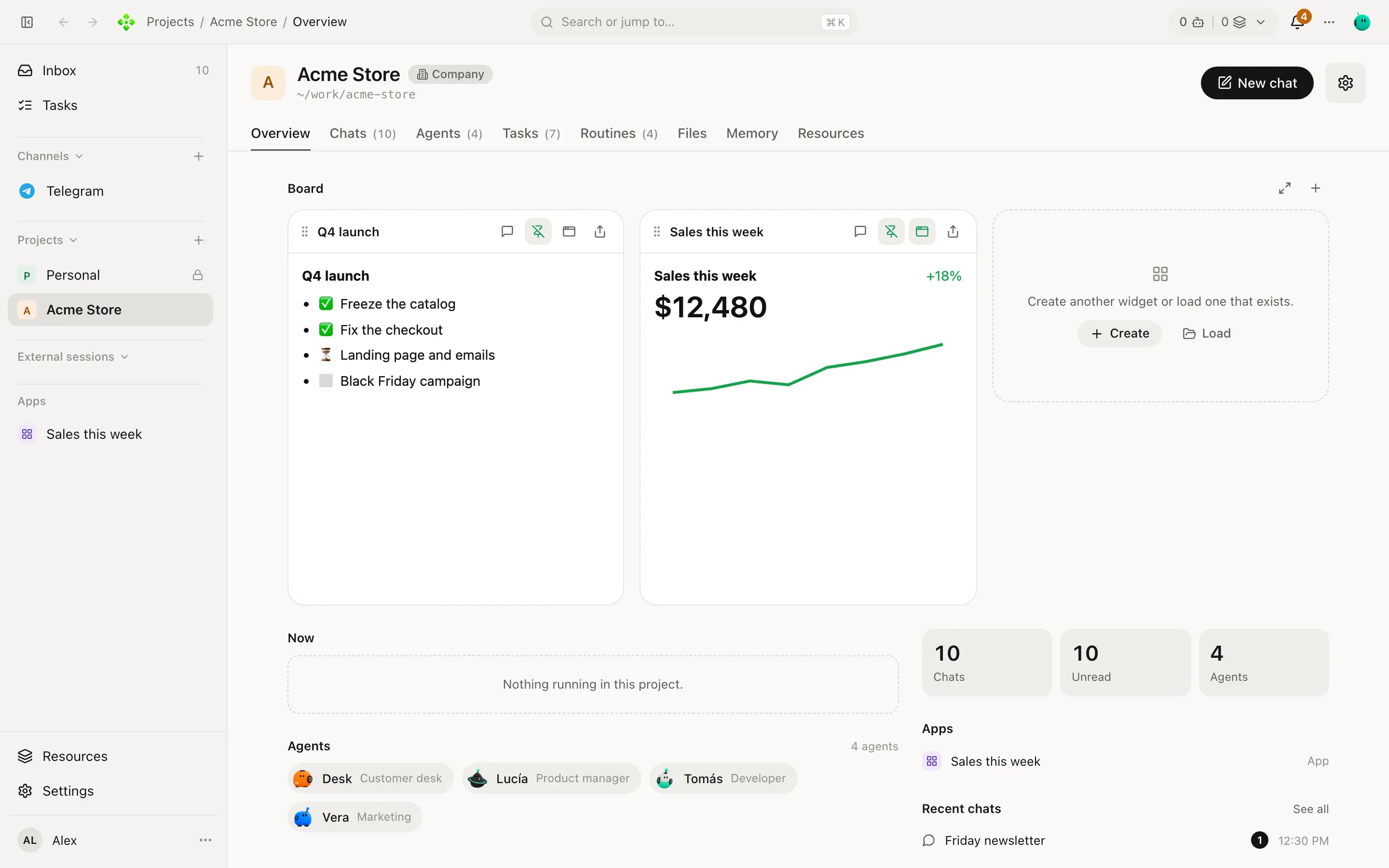
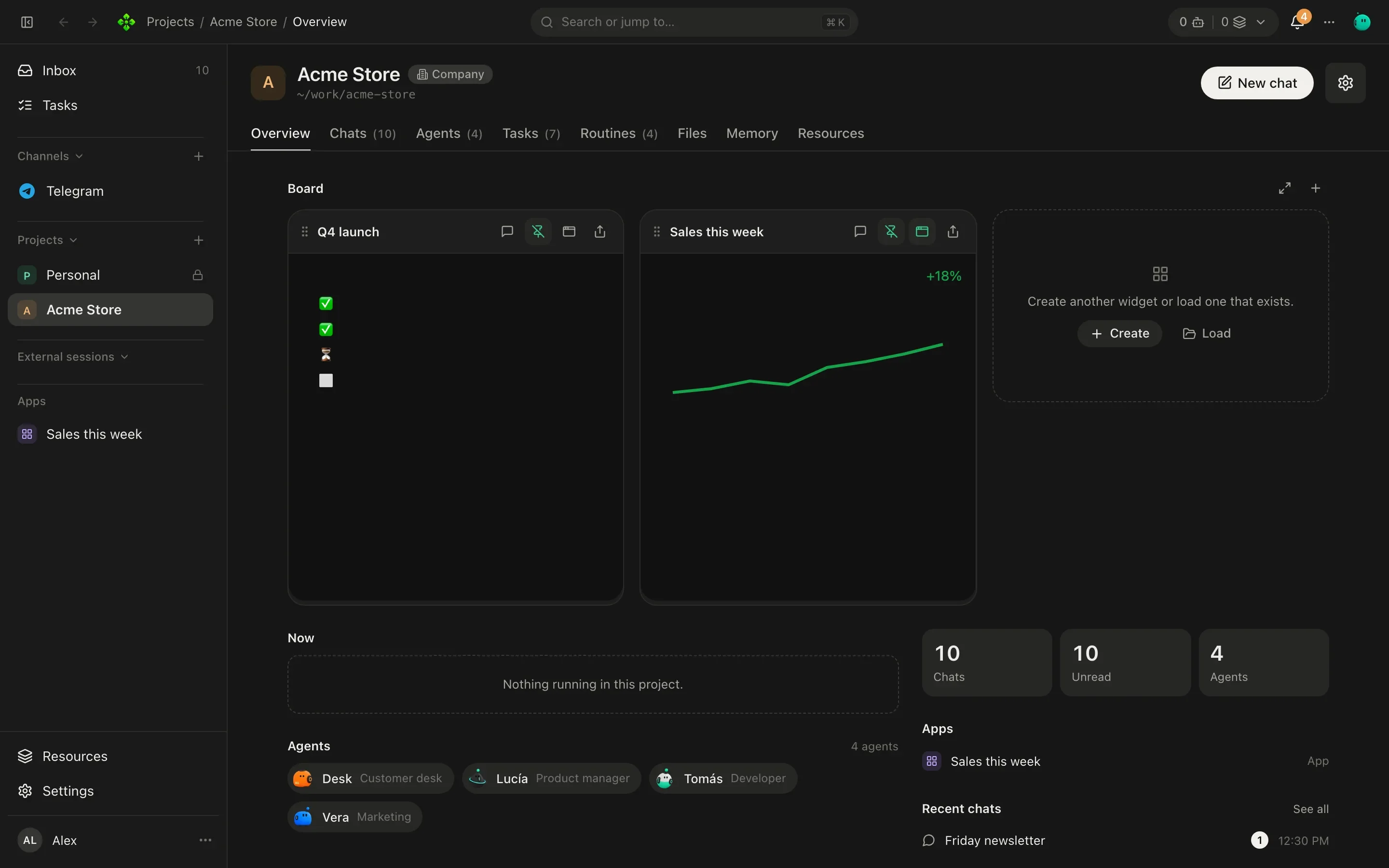
Section titled “Inside a project”Open a project from the sidebar and you get its tabs: Overview, Chats, Agents, Tasks, Routines, Files, Memory and Resources. The Overview is the project at a glance: a Board with the widgets you pinned, what is running now, the team, a few numbers and the latest chats.