
MCP servers
MCP (Model Context Protocol) servers add tools: a GitHub server lets agents read issues, a database server lets them query, and so on. APX runs the servers your agents use and keeps each tool behind your permissions.
Global and project servers
Section titled “Global and project servers”- Global servers are yours. Every project inherits them; a project can turn one off for itself, or stop using
the global ones altogether. Their environment and headers may use your variables
as
secret://NAME. - Project servers are declared in the project’s
.apc/mcps.json, committed with the repository:
{ "mcpServers": { "docs": { "command": "npx", "args": ["-y", "@acme/docs-mcp"] }, "status": { "url": "https://mcp.example.com/status" } }}A repository can name any command, so a project server starts only after you approve that exact definition. If
the file changes, it needs approving again. .apc/mcps.json never holds tokens: a definition that mentions
secret:// is ignored there.
Add, approve, remove
Section titled “Add, approve, remove”In Resources › MCP, + MCP opens New MCP server: a name, How it connects (Command or URL), and its Environment or Headers, where a value can be one of your variables. A project’s server shows Approve until you approve it; read the command first. Test starts it and lists its tools.
apx mcps # every server: status, tool count, error or targetapx mcps list acme-store # as one project sees themapx mcps add github -- npx -y @modelcontextprotocol/server-githubapx mcps add status https://mcp.example.com/statusapx mcps trust acme-store docs # approve a project's server as its file defines it nowapx mcps untrust acme-store docsapx mcps rm githubPut -- before a command whose arguments start with - (like npx -y), so apx doesn’t read them as its own
options. Environment and headers are edited in the panel.
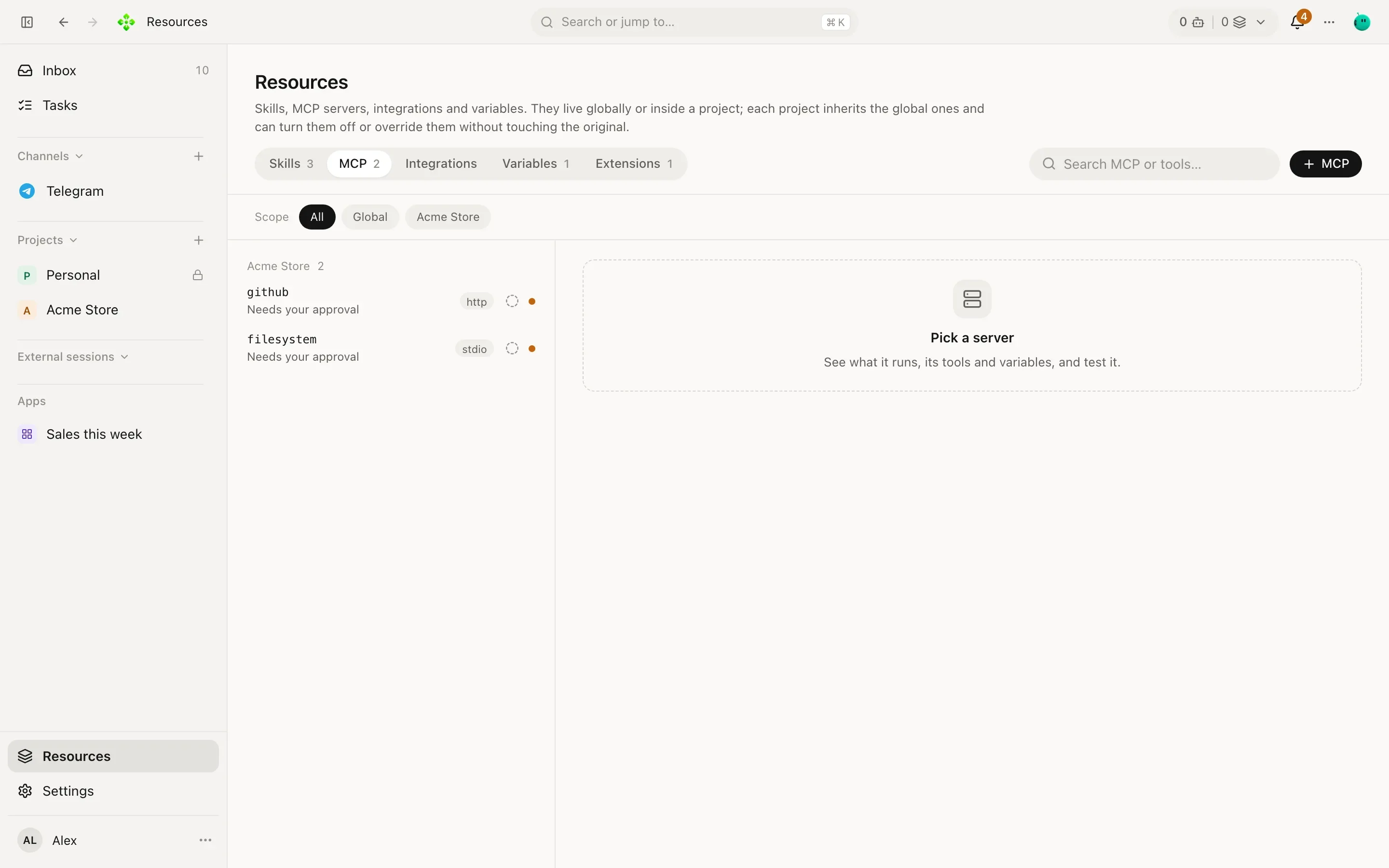
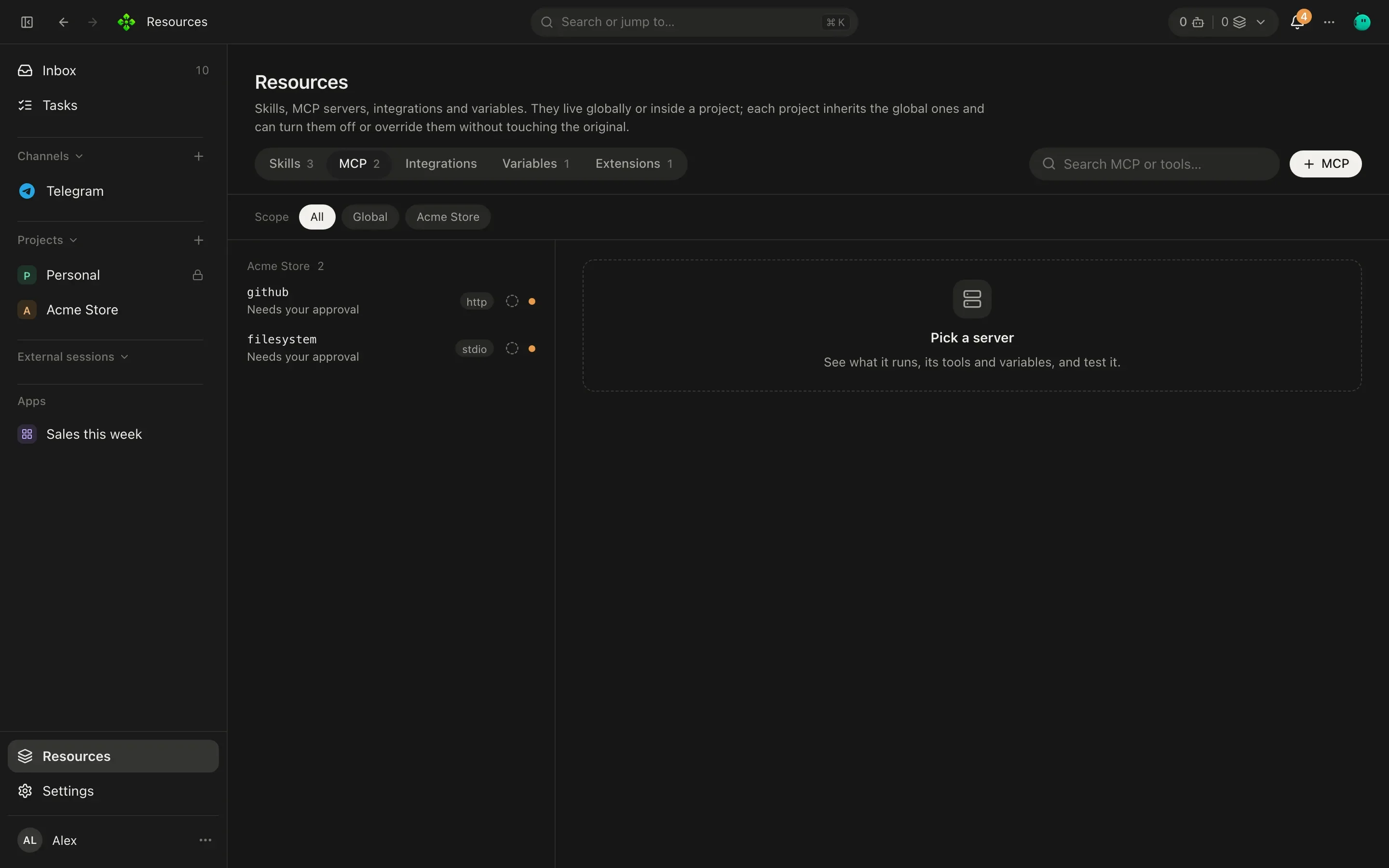
Servers don’t run all the time: a server is Ready and starts only when an agent first uses it.
Try a server from the terminal
Section titled “Try a server from the terminal”apx mcp tools, run and check talk to a server directly, which is handy when something doesn’t work:
❯ apx mcp check github
github: OK · 812 ms · 26 tools
apx mcp tools github # every tool with its schema and a ready-made run commandapx mcp tools github search_issues # just oneapx mcp run github search_issues '{"q":"repo:acme/store is:open label:bug"}'echo '{"q":"is:open"}' | apx mcp run github search_issues -Add --project <id> for a project’s server, and --scope global|project when a name exists in both.
Tool permissions
Section titled “Tool permissions”Each server has Tool permissions:
- Ask first: each agent asks you before using a tool that changes something.
- All allowed: no agent asks for these tools. If the server or a tool changes, they ask again.
- Some: click a tool to allow it (green) or to make it ask again.
On top of that, an agent’s own autonomy and its tools: list still apply, and anything you approved “always” for one
agent or chat shows under Allowed for one agent or chat. See Autonomy.
Why agents see only two MCP tools
Section titled “Why agents see only two MCP tools”Sending every MCP tool to the model on every call gets expensive fast. On a real install, ten ordinary servers brought 319 tools: a one-line answer cost 64,432 tokens of prompt.
So agents don’t get those tools directly. While any server is on and approved, they get two:
mcp_searchfinds tools by words or by server, with their descriptions and arguments.mcp_callruns one by its exact name.
The same one-line answer then costs 11,838 tokens, and the list of tools stays the same from call to call, which keeps the model provider’s prompt cache warm. Approvals, confirmations and the tool cards in the chat work exactly as if the agent had called the tool directly.